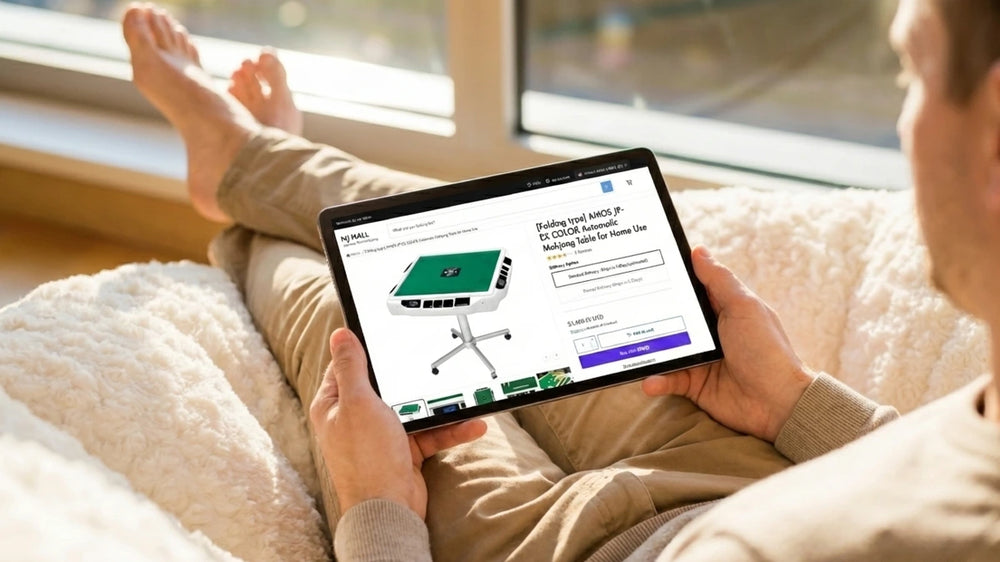
Japanese vs Chinese Automatic Mahjong Tables — A Real-World, Hands-On Comparison

Japanese vs Chinese Automatic Mahjong Tables — A Real-World, Hands-On Comparison
After years of playing and testing different automatic mahjong tables, I finally sat down with both a well-known Japanese model (AMOS JP-EX COLOR) and a popular Chinese model. On paper they seem similar. In the living room at 11 PM with friends? They feel like completely different worlds. This review focuses on what spec sheets don’t tell you: the sounds you hear, the touch you feel, and the small moments that make you love (or give up on) a table.
Read our Best Japanese Tables Guide
1) Feel & Sound: the First Thing You Notice


With the Chinese table, shuffles and stacks have a cheerful clatter that fills the room. Fun for a party, sure, but I found myself checking the clock after 10 PM. The Japanese AMOS, by contrast, gives you that soft, precise “tok” when tiles meet the felt. It’s the difference between a playful arcade and a focused studio.
- Japanese (AMOS): Subtle sound, controlled motion, and a satisfying, weighty tile feel.
- Chinese (various): Louder clack, lighter tiles; fine in busy rooms, less ideal for quiet apartments.
2) Build & Longevity: “Appliance” vs “Instrument”
The Chinese model I first bought was attractively priced and honestly good fun out of the box. But months later I met little quirks—occasional hiccups in tile feeding and uneven stacks. With the Japanese AMOS JP-EX COLOR, two years in, nothing has failed. When you peek inside, the parts feel over-engineered in the best way: clean tolerances, sturdy gears, and the calm confidence that this thing is meant to last.
- Japanese: Feels like a well-tuned instrument; if you take care of it, it will take care of you for years.
- Chinese: Feels like a casual home appliance; fun and affordable, but not built with the same precision.
3) The Late-Night Factor: Can You Play at 11:30 PM?
For me, this is the deal-maker. The Japanese table’s quiet mechanism means I can invite friends on a weekday and keep going without anxiety about neighbors. With the Chinese table, I caught myself whispering “maybe one last hand” because the shuffle sounded like a tiny storm in the next room. If you live in an apartment, this single point may decide everything.
4) Design & Space: Minimal vs. Flashy
Many Chinese tables love color and lights, which make them lively at gatherings. Japanese tables keep a low profile—clean lines, calmer colors, and folding or low-table options that genuinely help in small spaces. Mine sits in the corner of the living room, and guests often ask, “Wait, that’s a mahjong table?”
5) Maintenance: Can You Fix Small Things Yourself?
When my older Chinese unit needed attention, parts were a scavenger hunt. With AMOS, parts and guidance are organized and reachable. Knowing I can maintain it myself changed how I think about cost: I’m not buying two years of fun—I’m buying a decade of reliable nights with friends.
Quick Comparison (What It Feels Like to Live With)
| Aspect | Japanese Tables | Chinese Tables |
|---|---|---|
| Sound & Feel | Quiet “tok”, focused rhythm | Lively clatter, party energy |
| Build & Parts | Precision components, long-term view | Good enough, more variability |
| Home Use at Night | Excellent (apartment-friendly) | Can be loud late at night |
| Design & Footprint | Understated, folding/low options | Flashy, often fixed footprint |
| Maintenance | DIY-able with accessible parts | Parts/support can be tricky |
| Best For | Serious players & long-term owners | Casual play & lower upfront cost |
Editor’s Take: What I’d Recommend
If you want the “buy once, love forever” experience, go Japanese. The AMOS JP-EX COLOR hits the sweet spot for home use: quiet, steady, and adaptable. If you’re budget-first and play occasionally, a Chinese table can be a cheerful entry—just know what you’re giving up in late-night peace and long-term polish.
My personal pick for most people: AMOS JP-EX COLOR (Low Table / Folding Type)
Related Japanese Models I’ve Tried & Liked
- AMOS REXX III — Pro-grade speed and precision; the model used in Japan’s M-League. Great for clubs and serious enthusiasts. See REXX III
- AMOS JP2 — Quiet, compact, excellent value for first-time buyers and families. See JP2
“In the end, I wasn’t just buying a table. I was buying quiet nights I can actually enjoy.”
Next reads recommended for you
Keep the momentum — these articles deepen what you just learned.
![[Folding type] AMOS JP-EX COLOR Automatic Mahjong Table for Home Use.](http://mahjong-mall.com/cdn/shop/files/HQ-main2.jpg?v=1737856921&width=220)
![[Folding type] AMOS JP-EX COLOR Automatic Mahjong Table for Home Use.](http://mahjong-mall.com/cdn/shop/files/005.jpg?v=1737896344&width=220)
![[Folding type] AMOS JP2 Foldable Automatic Mahjong Table for Home Use.](http://mahjong-mall.com/cdn/shop/files/Pica-enhance-20250126101542.jpg?v=1737856862&width=220)


![[Folding type] AMOS JP-EX COLOR Automatic Mahjong Table for Home Use.](http://mahjong-mall.com/cdn/shop/files/003.jpg?v=1744921976&width=3840)